


The 1.2 cubic meter self-loading concrete mixer is a compact mobile unit that integrates a loader, mixer, and transport vehicle into one machine. It is an ideal choice for small and medium-sized construction sites that require on-demand concrete supply. The equipment is equipped with an integrated loading bucket (used for loading sand, aggregates, cement, and other materials) and powered by a diesel engine. Each batch can produce approximately 1.2 cubic meters of concrete, offering both efficiency and portability.
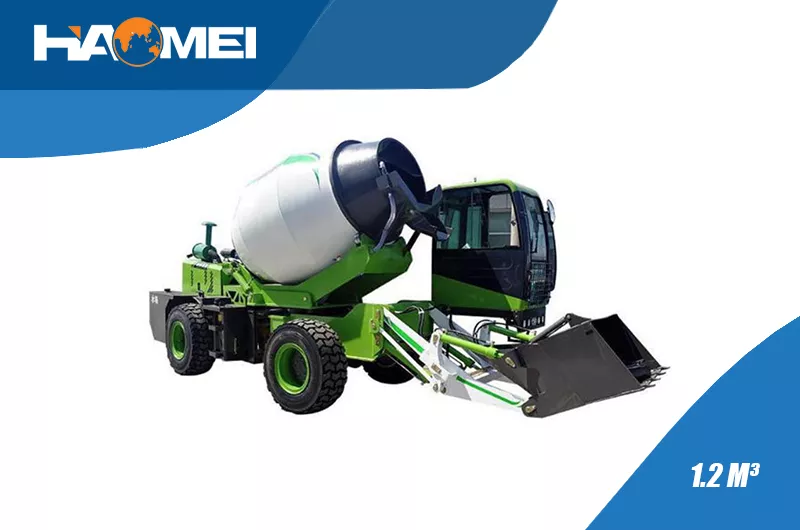
In terms of structural design, the 1.2 cubic meter self-loading concrete mixer features a narrow body, short wheelbase, and small turning radius. These customized design features give it significant advantages in working environments with limited height, width, and length, and it can be operated by just one person. This compact design is especially suitable for operations in narrow urban streets, rural alleys, or construction sites with restricted space.
Self Loading Concrete Mixer 1.2 Cubic Specifications
| Product Name | Self Loading Concrete Mixer 1.2 Cubic |
| Production Capacity (m³/Drum) | 1.2 |
| Rated Power (kW) | 55 |
| Drum Capacity (L) | 1700 |
| Max Speed (km/h) | 30 |
| Max Climbing Grade (°) | 30 |
| Drum Rotation | 270–360° |
| Fuel Tank (L) | 63 |
| Water Tank (L) | 400 |
1.2 Cubic Self Loading Concrete Mixer Structure
| Module Name | Main Components | Function Description |
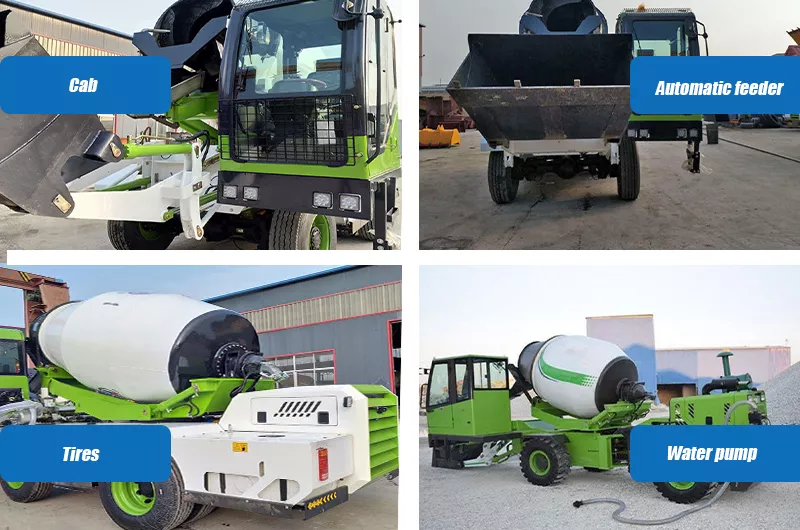
| Chassis System | Chassis, front and rear axles, tires, suspension | Provides driving and load-bearing capability for the whole machine, ensuring stability and passability on various terrains |
| Hydraulic Transmission System | Hydraulic pump, hydraulic motor, control valves, pipelines | Converts engine power into hydraulic energy to power the mixing drum and loading arm |
| Mixing Drum | Mixing drum, spiral blades, auxiliary blades | Stores and mixes concrete, preventing segregation and solidification |
| Discharging System | Discharge chute, hydraulic control mechanism | Controls accurate and efficient discharge of concrete |
| Cleaning System | Water pump, water pipes, high-pressure cleaning mechanism | Cleans the mixing drum and the entire machine, reducing solidification and blockages |
| Sub-frame | Main frame, connecting structures | Supports the mixing drum and hydraulic components, ensuring structural stability |
| Control System | Control levers, hydraulic control mechanisms | Controls the loading arm, mixing drum, driving, and other operations |
| Roller System | Roller frame, rollers | Supports stable rotation of the mixing drum |
| Feeding System | Loading arm, bucket, sensors | Automatically scoops materials and feeds aggregates, sand, and cement into the mixing drum |
| Electrical System | Wiring, control modules, instruments | Controls electrical functions and safety protection of the entire machine |
Self Loading Concrete Mixer 1.2 Cubic Applications
The 1.2 cubic meter self-loading concrete mixer has a wide range of applications, covering construction engineering, infrastructure development, water conservancy projects, road construction, and many other industries. In construction engineering, the equipment is mainly used for preparing concrete for residential buildings, commercial buildings, and industrial plants. It is especially advantageous on sites where large concrete mixer trucks cannot access.
In infrastructure development, self-loading concrete mixers are widely applied in road construction, bridge building, tunnel projects, airport construction, and more. The equipment is particularly suitable for on-site construction in remote areas far away from concrete batching plants. In mountainous regions, islands, remote villages, and developing infrastructure zones, it can operate independently without relying on external concrete supply.
In water conservancy projects, the equipment can be used for small dam construction, canal lining, and small hydropower station projects. Its mobility allows efficient operation on complex water conservancy construction sites, especially in mountainous areas with challenging terrain and poor transportation conditions.
In road construction, the 1.2 cubic meter self-loading concrete mixer is suitable for rural road hardening, urban road maintenance, and residential road construction. The equipment can produce concrete directly on the construction site, avoiding quality issues caused by long-distance transport and improving construction efficiency.
In addition, the equipment is widely used in special engineering fields such as military projects, emergency engineering, and disaster relief operations. In these special scenarios, its independence and flexibility enable rapid deployment and operation without external support.
Self Loading Concrete Mixer 1.2 Cubic Advantages
- High Automation: Automatically completes mixing, transporting, and discharging tasks, reducing operational difficulty
- Precise Batching Control: Built-in digital weighing system ensures accurate concrete mix for each batch
- Excellent Mobility: Four-wheel drive design, narrow body, small turning radius
High Degree of Automation
The equipment can automatically perform mixing, transporting, and discharging tasks, thereby reducing manual operation difficulty and labor intensity. Traditional concrete production usually requires four different machines — wheel loader, concrete batching plant, concrete mixer truck, and concrete pump — whereas the self-loading concrete mixer integrates all these functions into one machine.
Precise Batching Control Capability
The equipment is equipped with a built-in digital weighing system, ensuring precise mix ratios for each batch of concrete, thereby improving the quality and consistency of on-site concrete. The integrated weighing system measures the load in real-time as materials are lifted, allowing the operator to achieve the exact proportions required by the concrete mix design and ensuring consistency between batches.
Excellent Mobility
The self-loading concrete mixer features a four-wheel drive, self-propelled design, allowing smooth operation on various terrains, including rugged or narrow construction sites. The 1.2 cubic meter model is specially designed for narrow rural streets and constrained urban spaces, with smaller dimensions, capacity, rated power, and operating weight.
Additionally, the equipment offers flexible discharging capabilities. The mixing drum can rotate 270–360°, allowing discharge from multiple angles without repositioning the vehicle, saving time and effort. The forward-tilting discharge feature ensures more thorough and faster discharge, while the large water tank design meets the needs of working in water-scarce environments.
Comparison of Self Loading Concrete Mixers of Different Capacities (1.2m³ vs 1.8m³ / 2.6m³)
| Comparison Item | 1.2 m³ Self Loading Mixer | 1.8 m³ Self Loading Mixer | 2.6 m³ Self Loading Mixer |
| Typical Equipment Size (mm) | 7300 × 1800 × 3450 (more compact, suitable for narrow sites) | 7300 × 2650 × 3750 | 7800 × 2680 × 4100 |
| Applicable Space | Rural roads, narrow urban streets, small construction sites | Small to medium construction sites | Medium and large construction sites |
| Engine Power (kW) | 55 kW (low fuel consumption, sufficient to drive 1.2 m³) | 78 kW | 75 kW |
| Machine Features | Small size, flexible, fuel-efficient, low operating cost | Higher power, suitable for more intensive operations | Suitable for larger projects, stronger carrying capacity |
| Typical Use Cases | Rural infrastructure, small municipal works, small construction projects | Small to medium building construction, road engineering | Large infrastructure projects, commercial buildings |
| Target Customers | Small contractors, township construction teams, rental market | Medium contractors | Large contractors, engineering companies |
Comparison of 1.2 Cubic Self Loading Concrete Mixer with Other Types of Mixers
| Comparison Type | Self Loading Concrete Mixer (1.2 m³) | Stationary Mixer | Mobile Mixer | Forced Mixer | Traditional Concrete Mixer Truck |
| Function Features | Integrates loading, mixing, transporting, and discharging in one (multi-functional) | Mixing only, requires additional equipment (loader, batching machine, etc.) | Movable, but loading requires external equipment | Forced mixing via mixing shaft, strong mixing effect | Only transports concrete, no production capability |
| Loading Method | Built-in hydraulic loading system, can load independently | Relies on a loader | Depends on loader or manual labor | Depends on a loader | No loading capability |
| Mixing Principle | Gravity fall: drum rotates and materials repeatedly fall under their own weight for mixing | Gravity fall or forced | Gravity fall | Forced: blades press, flip, and throw materials | Gravity fall (to maintain concrete flowability) |
| Mobility | Four-wheel drive, highly mobile on-site | Fixed installation, not movable | Can be towed or moved within a small range | Usually fixed or semi-fixed | Strong road driving capability |
| On-Site Production Capability | Can produce concrete directly on the construction site | Can produce, but requires fixed site | Can mix on-site but limited functionality | Can mix on-site but requires feeding equipment | No production capability, only transport |
| Applicable Scenarios | Small to medium projects, rural construction, municipal maintenance, mobile operations | Large construction sites, precast factories | Small-scale mobile construction | High-quality concrete, small precast components | Concrete transportation on various sites |
| Dependence on External Equipment | Minimal (complete process independently) | High | Relatively high | High | Relies on batching plant supply |
| Core Advantage | Multi-functional, flexible, low labor demand | Large mixing volume, stable output | Suitable for simple sites | High mixing quality | High transport efficiency |
How to Choose a Self Loading Mixer
Besides capacity, selection can also consider the following aspects:
Identify Core Requirements: A self-loading mixer integrates loading, mixing, and transporting, saving significant labor. You need to assess your daily concrete demand, site road conditions, and space constraints to determine if the 1.2 cubic meter model is suitable.
Focus on Key Configurations:
- Drive Type: Four-wheel drive provides better off-road and climbing capability, suitable for complex construction sites.
- Engine Power: The power directly affects loading and mixing efficiency, and should be selected based on workload.
- Discharge Method: 270-degree or 360-degree rotating discharge is advantageous when working in confined spaces.