


A 4-cubic-meter concrete mixer truck is a mixer truck used for small-scale engineering projects, mainly for short-distance, small-batch concrete transportation and mixing. It is a very common and practical small-to-medium concrete transport equipment in the construction industry.
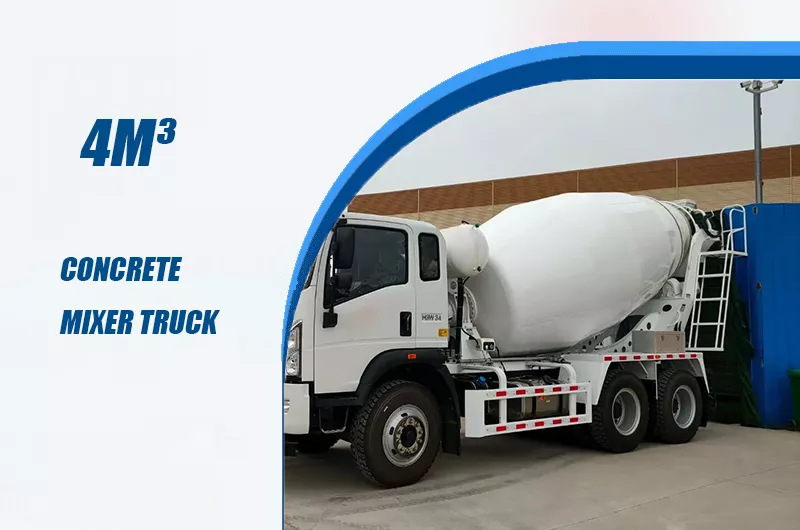
The term “4 cubic meters” refers to the geometric volume of the mixer truck, which is the theoretical maximum capacity of the mixing drum. However, during actual loading, considering safety, vehicle load capacity, and concrete characteristics, the actual transported concrete volume is usually around 3.5–4 cubic meters. Overloading is strictly prohibited.
4m³ Concrete Mixer Truck Specifications
| Item | Typical Parameters |
| Overall Dimensions | Length approx. 7.5–8.5 m, width approx. 2.5 m, height approx. 3.5–3.8 m |
| Drum Volume | Geometric Volume 4 m³ |
| Actual Load Capacity | About 3.5 – 4 m³ |
| Drum Rotation Speed | Loading/Mixing: 1–10 r/min, Discharging: ~15 r/min |
| Water Supply System | Water tank capacity approx. 250–350 L |
| Driving Mode |
Usually four-wheel drive, suitable for off-road operations |
4m³ Concrete Mixer Truck Features
Excellent maneuverability
Compact size, capable of traveling through narrow roads and residential areas; suitable for rural construction and mountainous projects.
High mixing efficiency
Optimized blade design improves mixing uniformity and reduces segregation.
Good fuel economy
Equipped with a lightweight chassis and efficient power system, reducing overall operating cost.
Easy operation
Dual control system in the cab and at the rear, making loading, transporting, and discharging safer and more convenient.
Low maintenance cost
Key components use well-known brand hydraulic systems, offering wear resistance and long service life.
4m³ Concrete Mixer Truck Structure and Working Principle
A standard 4-cubic-meter concrete mixer truck mainly consists of the following parts:
Chassis: Provides power and load-bearing capability.
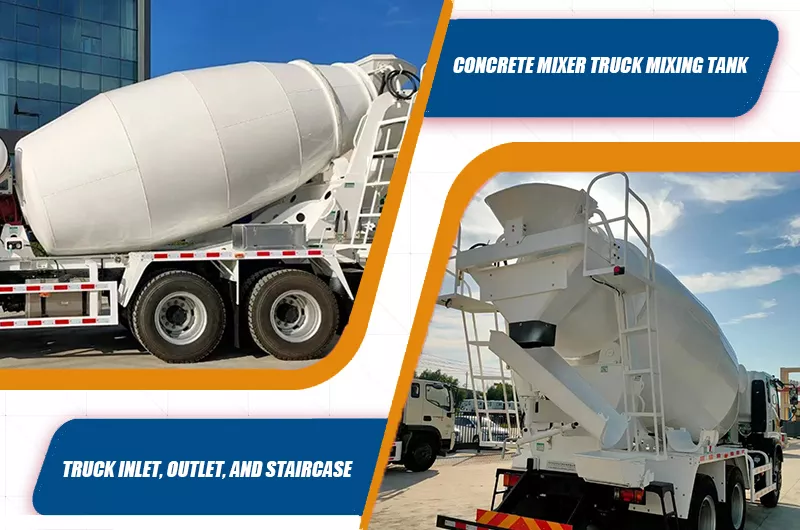
Mixing Drum:
- The core component, with spiral blades inside.
- During transportation, it rotates forward (feeding direction) at a low speed to prevent concrete from solidifying or segregating.
- During discharge, it rotates backward, pushing the concrete out through the blades.
Hydraulic System:
- Power is supplied by the PTO of the chassis to drive the hydraulic pump.
- The hydraulic motor drives the drum to rotate, with stepless speed adjustment.
Water Supply System:
Equipped with a water tank, used to add water into the drum during transportation (to adjust slump) and to clean the drum after discharging.
Control System:
Control levers are located both in the cab and at the rear of the vehicle, used to control drum rotation direction, speed, and operations such as loading, mixing, discharging, and stopping.
Feeding and Discharging Devices:
- Feeding Hopper: Located at the upper rear, receiving concrete from the batching plant.
- Discharge Chute: Extendable and rotatable, guiding concrete accurately to the pouring point.
4m³ Concrete Mixer Truck Advantages and Limitations
Advantages:
- High maneuverability: Smaller body size makes it suitable for city streets, township roads, and narrow construction sites.
- Economical and efficient: Lower purchase, fuel, and maintenance costs than larger mixer trucks. Highly cost-effective for small-to-medium projects or dispersed concrete demands.
- Wide applicability: Ideal for rural housing construction, small residential buildings, municipal engineering (road repair, pipeline construction), local bridge/tunnel pouring, etc.
- Good compliance: In regions with strict overload regulations, 4-m³ trucks can more easily meet total weight limits and face fewer road restrictions.
Disadvantages:
- Small single-trip capacity: For large or continuous pouring projects (e.g., high-rise building foundations), more frequent dispatching is required, making it less efficient than 8–12-m³ trucks.
- Limited transportation distance: Typically suitable for short to medium distances (within 20–50 km); long-distance transport is less economical.
Typical Applications of 4m³ Concrete Mixer Trucks
- Urban roads and small municipal projects
- Residential buildings, villas, and commercial housing projects
- Rural self-built houses and township road paving
- Small bridges, ditches, floor slabs, and other concrete pouring projects
- Construction areas with poor traffic conditions or limited space
4m³ Concrete Mixer Truck: Loading, Transporting, and Discharging Process
Loading and Mixing Concrete
After loading cement, aggregates, additives, and other materials at the concrete batching plant, the small concrete mixer truck starts the drum for continuous mixing to quickly produce uniform concrete.
Transporting Concrete to the Construction Site
The 4m³ mini concrete mixer truck is responsible for transporting the mixed concrete to the construction site within the specified timeframe, ensuring freshness and workability.
On-site Discharging Operation
Upon arrival at the construction site, the mixer truck adjusts the discharge chute through the hydraulic control system to smoothly unload concrete into the concrete pump, pouring groove, or other construction equipment for efficient supply.